
A paean to Inside Macintosh
1983-1985

My Inside Macintosh story starts with the Lisa computer. The first job I had at Apple was helping Lisa customers via a toll-free phone number. This was 1983 — ancient times. Our little support group was strictly a telephone operation. We didn’t do email or any other kind of online communication. The Lisa was pretty easy to support, and unfortunately there weren’t a lot of Lisa customers. So we had plenty of time on our hands. What to do with that time?
You probably know that the Lisa was not like any other mass-market computer. The Lisa had a graphical user interface, mouse, icons, and menus, and it predated Macintosh by a year. As an up-and-coming nerd, I was fascinated by the Lisa and I loved that I got paid to play with one all day. And I started to wonder: how did you write software that worked like these amazing programs: LisaDraw, LisaWrite, and so on? I wasn’t a software engineer, but I liked to write little programs for fun. How did Lisa programmers make the magic? Could I make some?
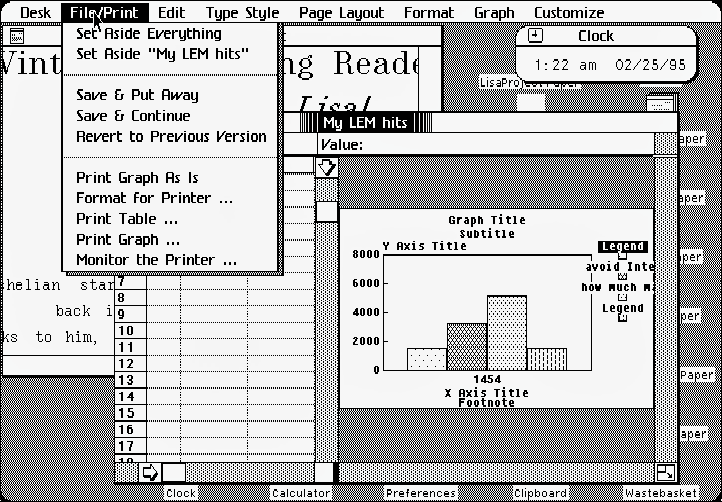
No, I could not. I found out that the Lisa wasn’t designed as a platform for outside developers. The applications that came with the Lisa were all created inside Apple by engineers on the team with intimate knowledge of how it all worked. Nobody else could play — not even other folks at Apple. I was disappointed. But I also learned that Apple was working on something else, a computer called Macintosh, the “people’s Lisa.” THAT one was very much a platform for developers to write software. And I had a friend over there.
My buddy Cary Clark was working on the Macintosh team, specifically charged with helping outside developers write software for the secret new machine. He sent me what he accurately referred to as “an incredible stack of documentation,” a bunch of loose pages organized into chapters. These would eventually become a book called Inside Macintosh. Each chapter had a cover page with the name of the chapter and other relevant info.
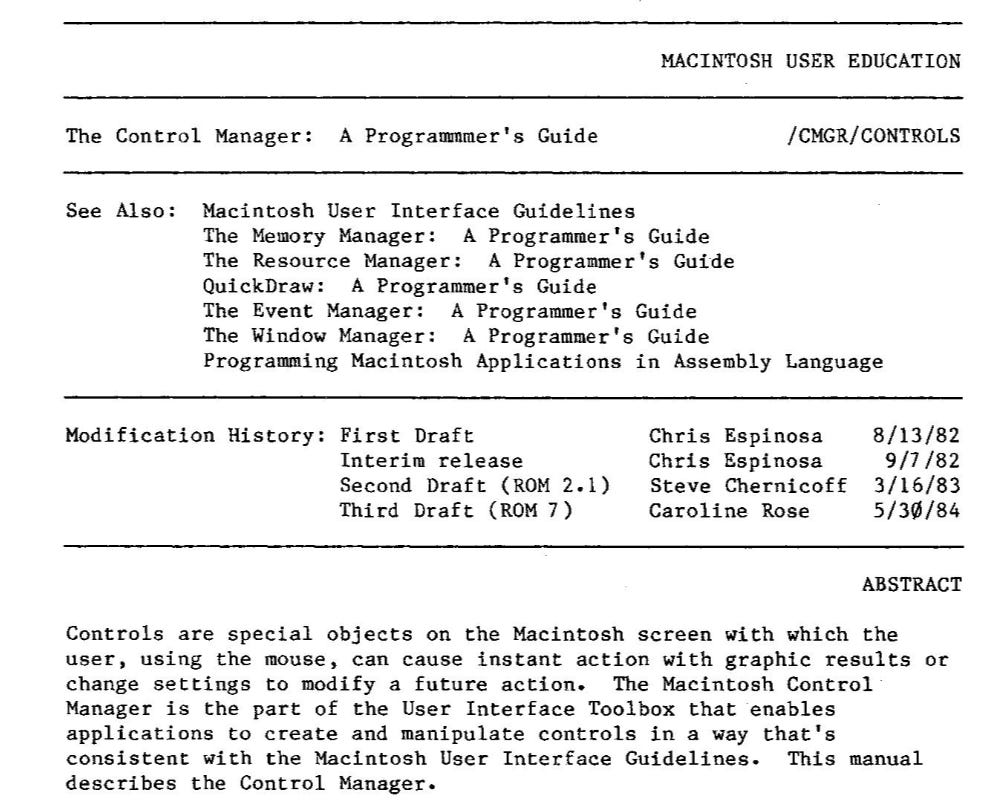
The chapters had fantastical names like The Window Manager and The Event Manager. And there were lots of chapters! Each chapter revealed how to create some essential part of the magic, like windows, buttons, or menus. The Macintosh software, the user interface, was incredibly audacious. The Mac’s point of view seemed to be that other computers before it (except Lisa) were now out of date. This was how we were going to do it from now on. It was self-evident that this was a better way. And if you wanted to help create the software of the future, you needed to read up and learn this.
Inside Macintosh was nothing less than a book of magic spells. If you wanted a window with scroll bars, all you had to do was write some Pascal code and make a few procedure calls. You didn’t have to be a genius. Apple supplied the geniuses and they had written the code for you. It was built in. And Inside Macintosh calmly told you all about it. Just laid out the secrets of the universe right there before you. I was stunned by the detail and clarity of the documentation, and the promises it made on behalf of the software. Could I really create wonderful graphical applications myself just by doing what it said?
Of course, I had no access to a Macintosh to confirm or try out any of this. Inside Macintosh might as well have been science fiction. I desperately wanted to try it out for real.
It wasn’t just the contents of Inside Macintosh that intrigued me. It was the whole aura. I was fascinated by the names of the authors on each chapter’s cover page – names of actual people! I had heard of Chris Espinosa, who wrote the wonderful Apple II Reference Manual. His name appeared on several chapters. But who was Caroline Rose, who seemed to have written most of this documentation? Who were Bob Anders, Steve Chernicoff, and these others who were teaching the world this magic? Could Bradley Hacker be the name of a real person?
I’ve known brilliant engineers who don’t need documentation in order to figure out how things work. But I didn’t know any of those types who were writing Mac software in 1983. The Mac was just too different, too novel, too revolutionary. Without Inside Macintosh, there would have been no Mac software made outside Apple. And I certainly wasn’t one of those brilliant engineers myself. I always needed and appreciated good documentation. I could tell Inside Macintosh was great before I even had a Mac to try it out.
A man on the inside
The more I found out about the Mac, the more I knew I wanted to spend all my time working with it. I learned there was a job opening on Cary Clark’s team in the Mac group. I schemed to get that job. After I did, I found out that each Mac software engineer reviewed the chapters about their part of the software before the drafts came out. After that, most of the feedback came from outside developers or tech support people like Cary and me. I could tell the engineers appreciated the quality of the docs and Caroline’s work. Andy Hertzfeld, one of the key Mac software engineers, said that if Caroline had trouble understanding something, it probably meant that the software design was flawed.
Once I was in the Mac group, at last I had a Macintosh, plus a Lisa, which was how you developed software for the Mac in those days, and even an Apple III to act as a debugging terminal. Of course I had my collection of Inside Macintosh chapters. I could finally try writing programs for the Mac.
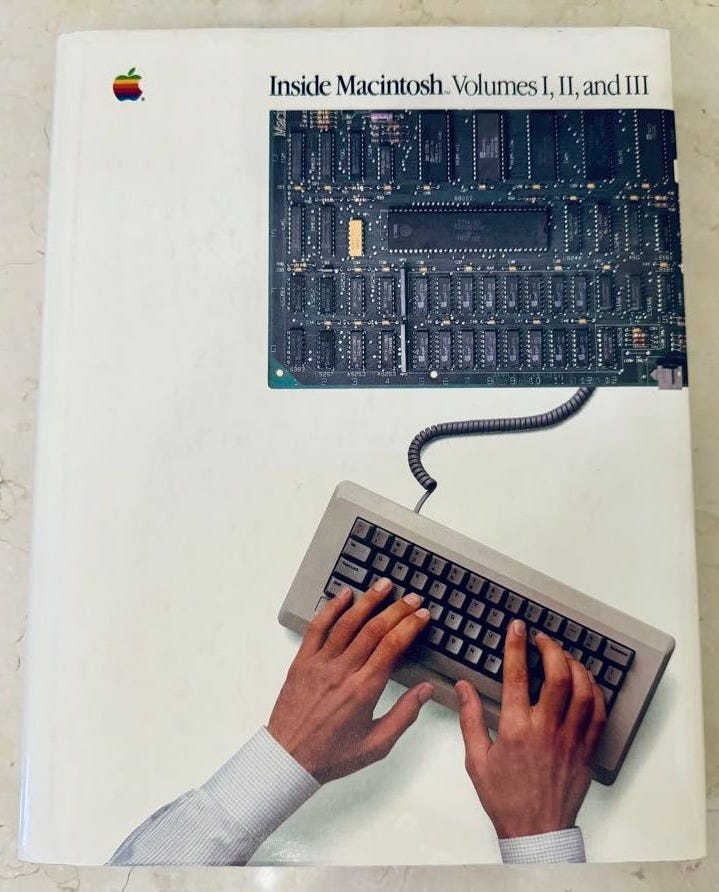
Now that I could write programs, I learned that Inside Macintosh wasn’t just well-organized and well-written. It was actually useful for its intended task. And I got to meet and work alongside those writers whose names had become legendary to me – especially Caroline Rose, who wrote the bulk of the words and was responsible for the entire product of Inside Macintosh. I remember one of the engineering managers saying that Inside Macintosh was as great a technical achievement as the Macintosh system software itself. To be fair, maybe I’ve hallucinated that he said that. Either way, that claim is worth an argument.
I spent so much time reading Inside Mac and writing programs that I became a reviewer of the documentation. I was excited whenever I could come up with a useful comment or suggestion (and rarely, a correction) for Caroline. I think I’m the one who convinced Caroline to add “rhymes with plunger” after hearing too many outside developers mispronounce the name of the Munger function with a hard G. And when Inside Macintosh was published, I was honored to see myself credited with helping the book along. Most important, I got to know Caroline and we started a friendship that still continues.

I still pick up Inside Macintosh from time to time and read a bit of it, just to relive those days. Inside Macintosh is still the greatest technical documentation I’ve ever seen, and Caroline Rose is the best technical writer I’ve ever read. And I know there are many people who were around back then who agree.
The jaw-dropping part of this is the realization that the Apple Lisa had no developer documentation. I don't think it ever occurred to me in 1983 that something was missing. Some manager should have gotten fired over that, and that manager was me.
I still have a full set on a shelf in my office--such great software development memories. I never thought I'd be reviewing and writing sample code for them in the '90s. Life is full of wonderful surprises.